

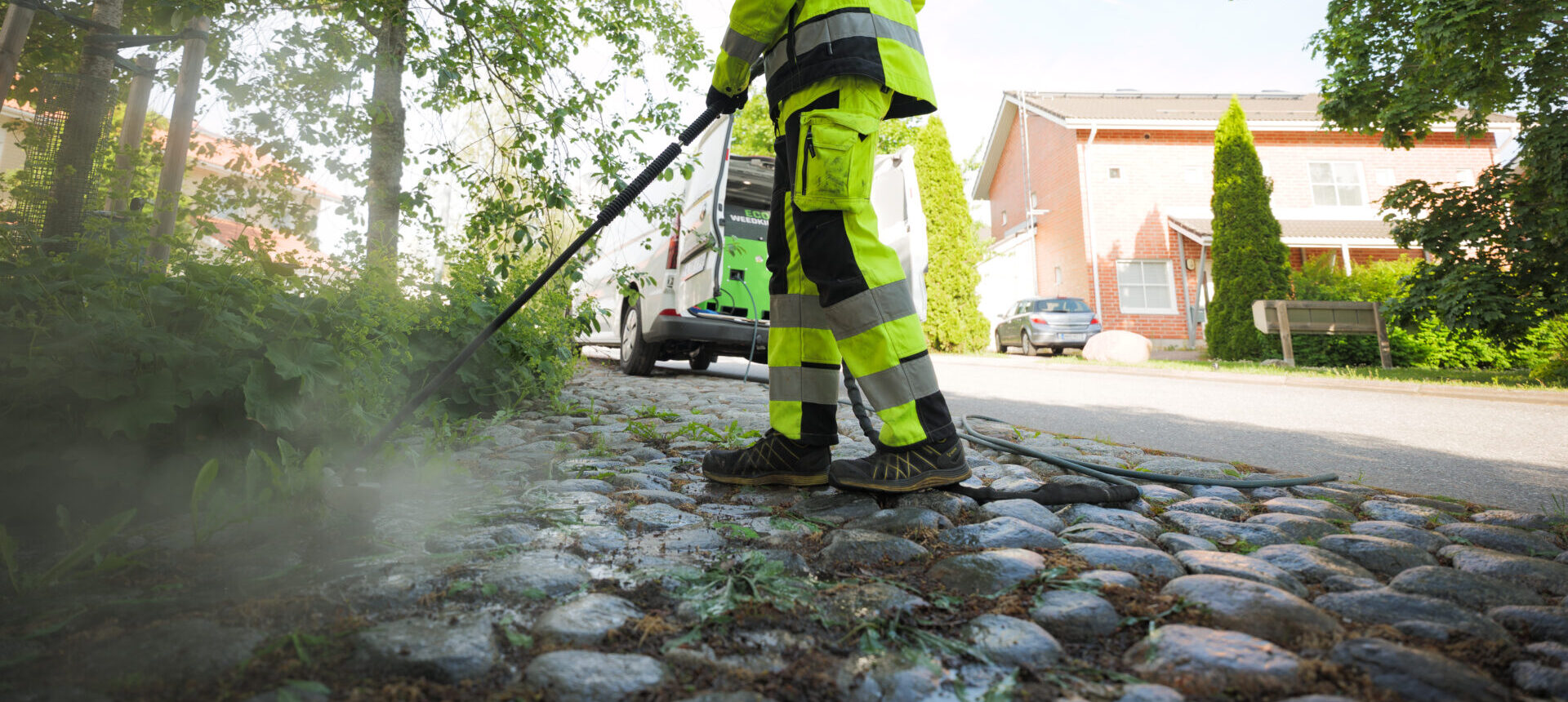
Deep-rooted invasive species require longer treatment times
Deep-rooted and difficult-to-control invasive species, such as Japanese rose (Rosa rugosa), require greater water volumes and longer treatment times. We recommend approximately one minute of treatment per square metre to ensure that a sufficient amount of hot water — and therefore enough root-destroying thermal energy — penetrates deep into the extensive root system and vegetation.
For example, when treating a 15 m² area covered with Japanese rose, we recommend a minimum of 30 litres of water per square metre.
Recommended water volumes for different vegetation types
- Standard weed control: 2–3 l/m²
- Deep-rooted plants and untreated areas: 3–5 l/m²
- Harmful invasive species and woody plants: 10–40 l/m²
In areas fully covered by weeds, the typical treatment capacity of the PRO40H unit is approximately:
- 400–1,200 m² per hour
- 3,000–9,000 m² per working day
Factors affecting work efficiency
A sufficient treatment frequency is typically 2–4 treatments during the growing season. Water supply arrangements have a significant impact on operational efficiency, and in hot water treatment, the largest cost factor is usually labour time, since heating water itself is relatively inexpensive.
The capacity of Eco Weedkiller PRO units is based on the continuous production of 100 °C water. In practice, however, treatment efficiency depends on factors such as vegetation density, plant species, biomass volume, and water use.
100 °C water production capacities of Eco Weedkiller units
- PRO10+: 14 l/min = approx. 840 l/h
- PRO20 Dual: 20 l/min = approx. 1,200 l/h
- PRO40H: 40 l/min = approx. 2,400 l/h